


-
FTIR-3000
-
YUAN ZHENG
FTIR-3000 Gas Analyzer is developed based on Fourier Transform Infrared Spectroscopy (FTIR) technology. It can simultaneously monitor multiple gas components in exhaust gas, including SO2, NOx, NO, NO2, CH4, HCl, HF, CO, CO2, O2, H2O, etc. Other gas components also can be extended as required, such as NH3, SO3, N2O, etc.
FTIR-3000 is featured with high precise waste incineration/ultra-low flue gas emissions deterministic and quantitative analysis. One analyzer can measure more than 10 gas components. It is compact design, highly integrated, that greatly reducing the investment & maintenance costs for continuous emission online monitoring system.
Working Principle
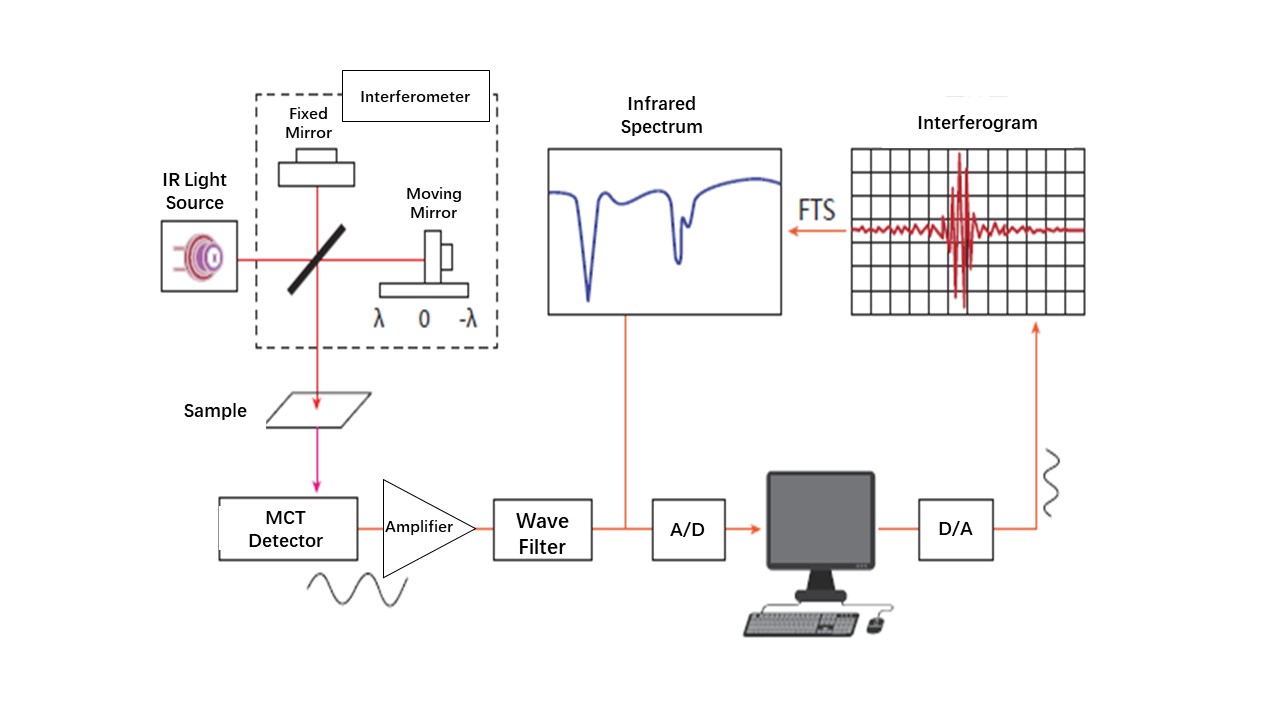
The FTIR-3000 Gas Analyzer is designed based on the principle of Fourier Transform Infrared Spectrum Technology. The sample gas molecules absorb specific frequencies of infrared light energy, and form the corresponding absorption spectra. It can be used to simultaneously measure multiple gases.
The analyzer mainly consists of an infrared light source, aperture, interferometer (beam splitter, moving mirror, fixed mirror), sample gas chamber, detector, as well as various infrared mirrors, lasers, control circuit boards, and power supplies.
The light emitted by the light source is split into two beams by a beam splitter, one beam is transmitted to the moving mirror and the other beam is reflected to the fixed mirror. Two beams of light are reflected separately by a fixed mirror and a moving mirror before returning to the beam splitter. The moving mirror moves in a straight line at a constant speed, resulting in an optical path difference between the two beams after being split by the beam splitter, this causes the interference. The interference light passes through the sample gas chamber after converging in the beam splitter, and the interference light, which containing the sample gas information reaches the detector after passing through the sample gas. The detected signal is digitized and Fourier transformed by a computer. The infrared absorption spectrum of the sample gas been obtained finally. Each gas has absorption at a specific position in the spectrum. Through analyzing the channel spectrum, the concentration values of each gas can be calculated.
Application
• Waste incineration power plant;
• Hazardous waste incineration;
• Medical waste incineration;
• Biomass power plant;
• Petroleum metallurgy and petrochemical


